

When Disease Breaks the Categories We Rely On
What a medical case is quietly revealing about health, immunity, and responsibility
Most of us were taught that disease fits into clean categories.
You either have an infection or you have cancer. Something is either foreign or it’s you. The immune system either works or it fails.
A recent medical case quietly dismantles those assumptions.
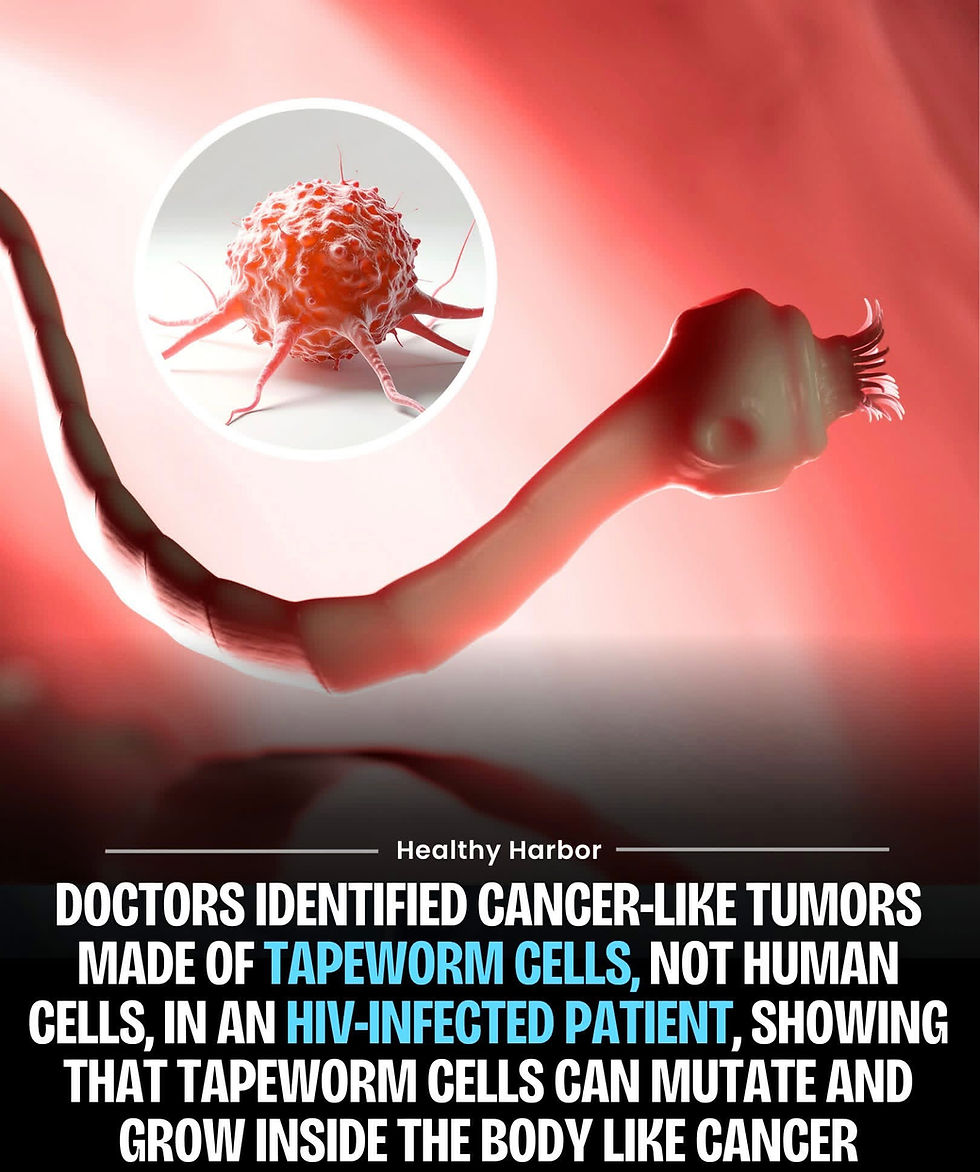
In this case, doctors discovered tumours in a severely immunocompromised man that looked and behaved like cancer - but the cells weren’t human. Genetic testing revealed the growths were made of cells originating from a parasitic tapeworm. These foreign cells had mutated, multiplied, and invaded human tissue in a way that mirrored malignancy.
This was not a typical infection. And it was not cancer in the conventional sense.
It was something in between.
What’s actually happening here
This case did not reveal a new widespread threat. It revealed a breakdown of regulation.
The patient’s immune system was profoundly compromised. In a healthy body, multiple layers of oversight prevent foreign organisms from surviving, let alone integrating into tissue and behaving destructively. But when those layers fail - deeply enough and long enough - boundaries dissolve.
What followed was not random. It was opportunistic.
Life, in any form, expands into unguarded space.
This isn’t a story about parasites turning into cancer. It’s a story about what happens when the body loses its ability to govern itself.
Why this matters beyond this single case
Modern medicine is excellent at naming conditions, targeting mechanisms, and treating symptoms. What it often struggles with is context.
This case challenges us to see health less as a battlefield and more as a system of order:
cells respecting limits,
tissues maintaining integrity,
immunity enforcing boundaries rather than just attacking invaders.
When that order collapses, problems no longer fit into neat diagnostic boxes. Infection and malignancy begin to overlap. Labels become less useful than understanding why regulation failed in the first place.
This is not about fear — it’s about foundations
For most people, this case changes nothing about daily risk. It is extremely rare and occurred under extreme conditions.
But it does raise an important question we don’t often ask: What conditions allow disease to take hold at all?
Not just biologically - but structurally, emotionally, and environmentally.
Many people reading this have experienced moments where:
illness lingered longer than expected,
recovery stalled without a clear explanation,
the body felt less resilient than it once did,
symptoms didn’t match tidy diagnoses.
These experiences often get minimized or fragmented across specialists. But they point to something deeper: when foundational support erodes, the body adapts in ways we don’t always recognize as meaningful—until something breaks.
A different way to look at wellbeing
One’s wellbeing is not maintained by fighting harder.
It’s maintained by restoring coherence.
Order precedes healing.
This case is a reminder that resilience depends on:
intact boundaries,
steady regulation,
and systems that are supported long before crisis appears.
Your experience matters here
Have you ever felt that your health challenge didn’t quite fit the explanation you were given?
Have you noticed patterns of stress, depletion, or suppression preceding physical symptoms?
Have you experienced recovery only after addressing something deeper than the surface diagnosis?
If you’re willing, share what you’ve noticed.
Your lived experience is part of the larger conversation we’re only beginning to have - about what health truly requires, and why prevention starts long before disease has a name.
👇 Comment below with what this brings up for you.
Read the original case report directly at the New England Journal of Medicine (NEJM):
🔗 Malignant Transformation of Hymenolepis nana in a Human Host (NEJM) — this is the formal article describing the finding of cancer-like tumors composed of tapeworm cells in an immunocompromised patient.
There’s also a related correspondence on the case:
🔗 Comment: Malignant Transformation of Hymenolepis nana (NEJM) which discusses the same case in follow-up form.
For a summary of the science and context from PubMed (including the DOI and authors), here’s the PubMed entry:
These links will let you explore the original medical evidence and details yourself.


Comments